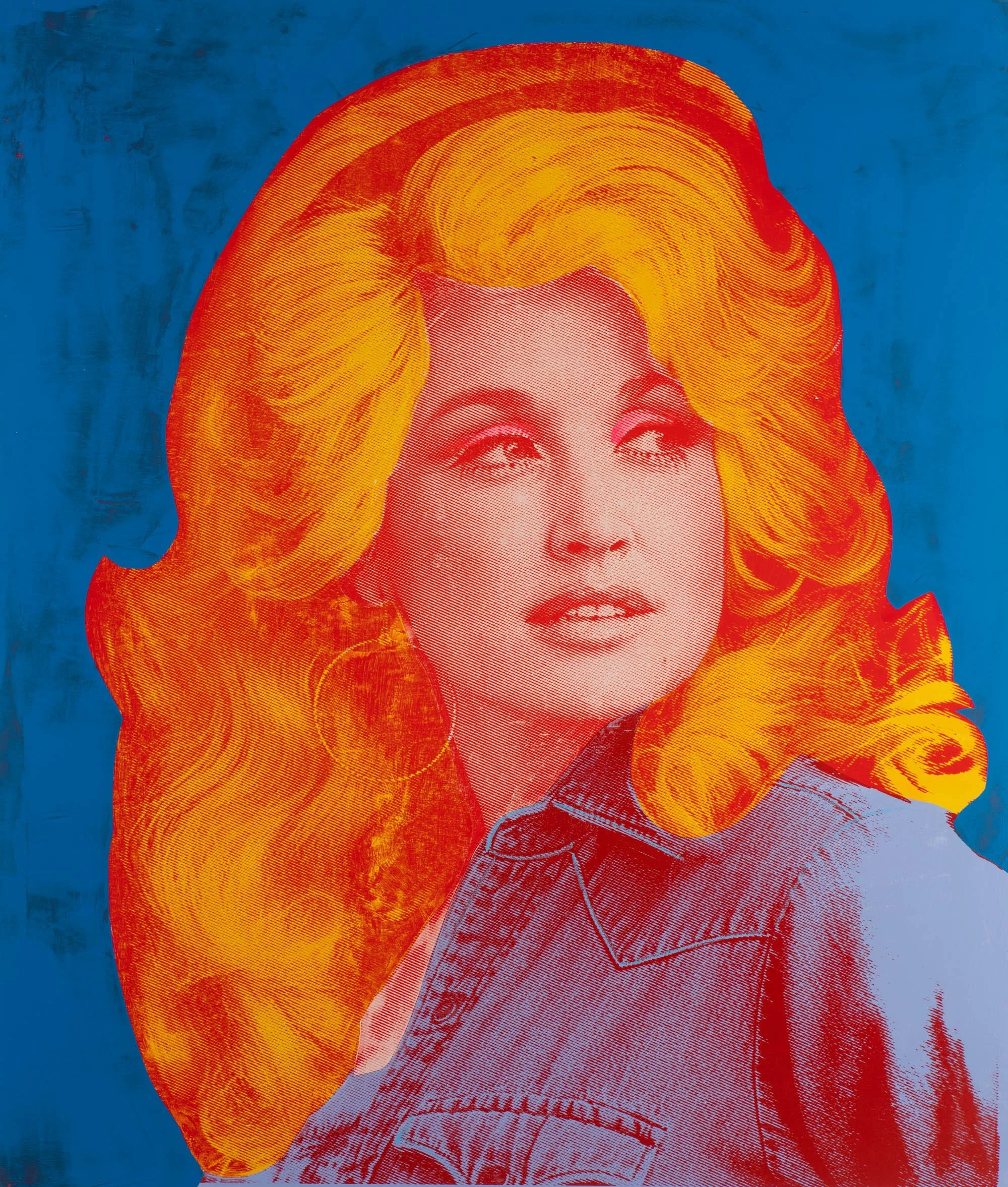
Remembering Dolly Parton (1946-2026)
Dolly Parton died August 25, 2026, at 80. A note on what she built, and why she belongs in pop art more than almost any other subject Dallas artist Dane Shue has painted..
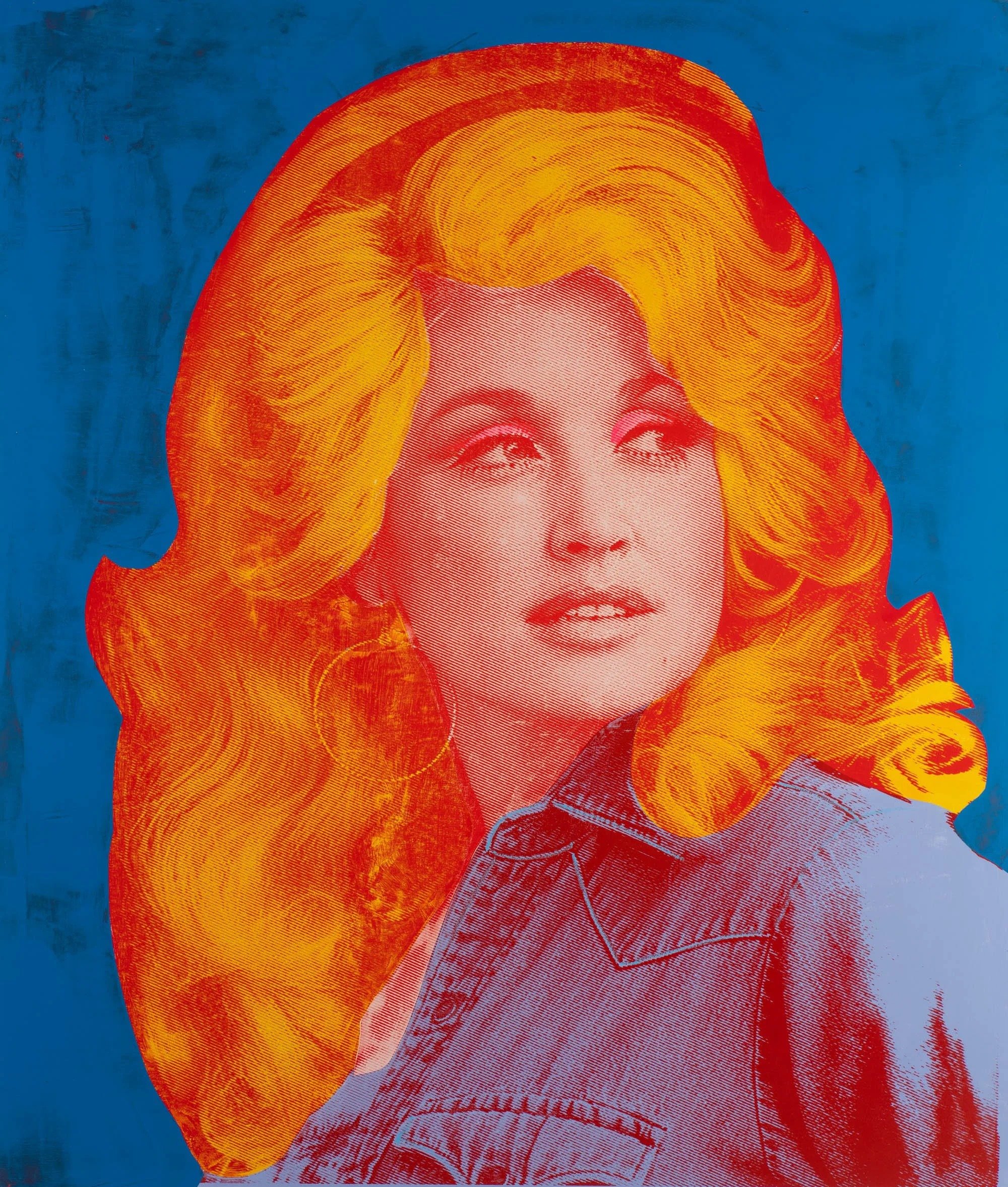
Dolly Parton died August 25 in Nashville. She was 80.
The image will do most of the remembering. The hair, the lashes, the rhinestones, the laugh. She assembled every bit of it herself, on purpose, and she was funnier about it than anyone else in the room, which gave the world permission to underestimate her. That was always the trick. The costume was loud enough to hold the eye, and while everyone was busy looking at it, she was building something else entirely.
What she built
More than 200 million free books mailed to children through her Imagination Library. A theme park that has employed her neighbors in the Smoky Mountains for forty years. A million dollars, given without a press conference, toward the research that became the Moderna vaccine. She never once made a performance out of the giving.
Why she keeps showing up in the studio
She is one of the easiest people alive to paint. The hair, the lashes, that smile. Four flat colors and everybody knows who it is from across the room. Warhol only got to Marilyn after she was gone. Dolly was here the whole time, changing the look every few years and giving anybody with a brush something new to work from. That is why she has been on this studio table more than almost anyone else, in silkscreen, spray paint and decoupage, on canvas, plywood and aluminum.
Dolly Parton, 1946-2026. Godspeed.
Anthony Bourdain in Pop Art
Anthony Bourdain still feels like one of the most alive people to ever appear on television. Long after Kitchen Confidential and Parts Unknown, people keep returning to his work because he offered something rare: total honesty. He never performed enthusiasm he did not feel, and he never talked down to the places or people he visited. That kind of presence does not fade. It only becomes more valuable with time.
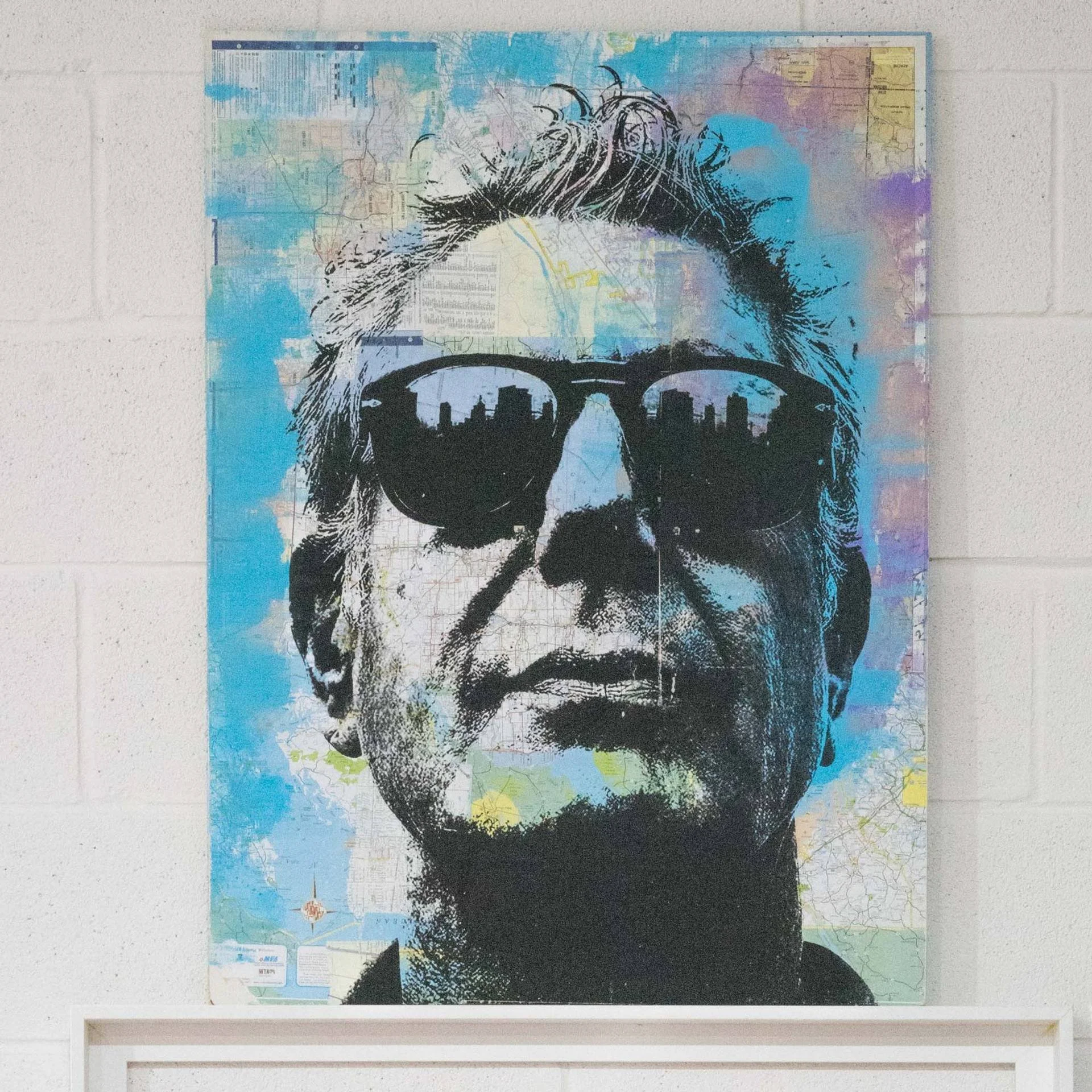
He put it simply: “Your body is not a temple, it’s an amusement park. Enjoy the ride.” That one line captures the way he moved through the world, hungry for experience rather than approval, always ready to say yes to the next plate, the next flight, the next stranger’s table.
Bourdain changed what travel television could be. Before him, food and travel shows tended to stay polished and safe. He brought in politics, history, humor, and real emotion, often all in the same episode, and he insisted that a bowl of soup on a plastic stool deserved the same respect as a tasting menu in a five star dining room. An entire generation of chefs, writers, and travelers point to him as the reason they started paying closer attention to the world outside their own kitchen.
This portrait is a small tribute to that spirit. Bold color and graphic contrast feel right for someone who approached the world with so much appetite and so little pretense. Years later, his voice is still the one people quote when they talk about why travel matters.
If you want one of your own, the Anthony Bourdain Pop Art Print is available in the shop, ready to frame and hang.
Queen Elizabeth II in Pop Art
Few figures in modern history are as instantly recognizable as Queen Elizabeth II. For seventy years she appeared on stamps, currency, and television screens around the world, which makes her a natural subject for pop art. Andy Warhol painted her in 1985 as part of his Reigning Queens series, turning the monarch into the same kind of repeated, colorful icon he made of Marilyn Monroe.
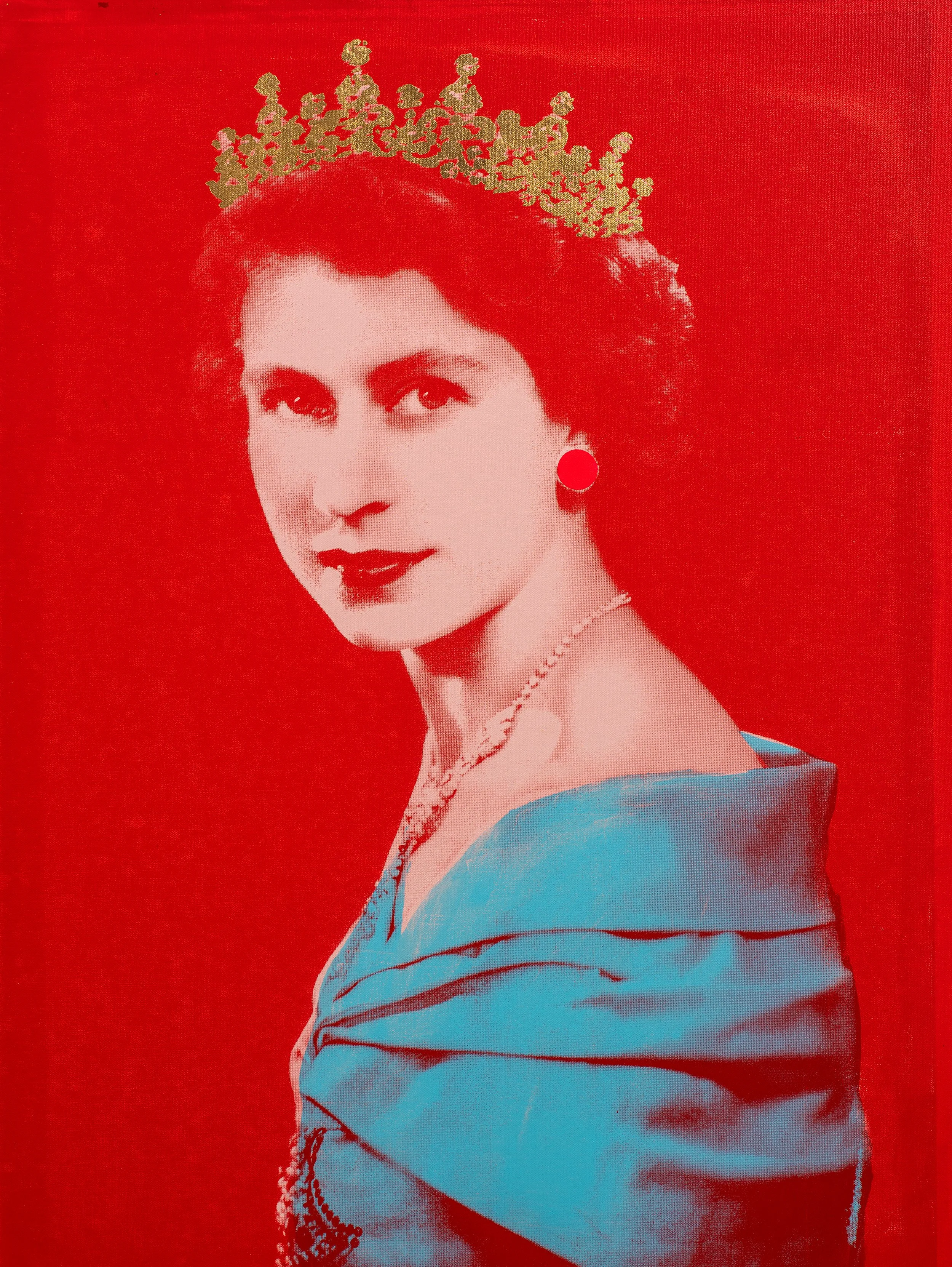
This portrait continues that tradition. Bold color blocking and graphic lines echo the formal portraits she sat for throughout her reign, while giving the image a modern and playful edge. She represented steadiness through enormous change, from the aftermath of World War II through the rise of the internet age, and that mix of tradition and transformation felt like the right story to tell through pop art.
Queen Elizabeth II passed away in 2022, closing out the longest reign in British history. Her image remains one of the most reproduced in the world, and this piece is a bright and bold way to hold onto a small piece of that history.
If you want one of your own, the Queen Elizabeth II Pop Art Print is available in the shop, ready to frame and hang.
Pop Art Portraits of Music Legends: From Bowie to Amy Winehouse

Acrylic and Spray Paint on Canvas • 36×36 in
This Amy Winehouse pop art painting is an original, one-of-a-kind work in acrylic and spray paint on canvas, measuring 36×36 in. Hand-finished and signed by Dallas artist Dane Shue, it brings bold color and graphic energy to any space — ready to hang.
There’s a reason musicians make such powerful subjects for pop art. The genre was born alongside modern celebrity, and few people embody that electric, larger-than-life energy like the artists who defined music history. In my Dallas studio, painting music legends has become some of my favorite work — capturing not just a likeness, but the attitude, the era, and the sound a single image can carry.
This post is a quick tour through the music portraits in my collection, and the stories behind a few of them.
The faces that defined an era
A great music portrait does more than show a famous face. It has to feel like the music. A David Bowie painting needs the otherworldly glamour of the Aladdin Sane years. An Amy Winehouse portrait has to hold both the beehive-and-eyeliner icon and the raw vulnerability behind it. Elvis demands swagger; Lauryn Hill demands soul. Getting that across in paint — through color, mark-making, and gold leaf — is the whole challenge, and the whole joy.

Acrylic and Silkscreen on Canvas • 30×40 in
This striking Elvis Presley pop art painting captures the King's rock-and-roll charisma in acrylic and Silkscreen on Canvas. Measuring 30×40 in and ready to hang, it brings bold color and color to any space — a one-of-a-kind original, signed by the artist and created in Dallas, Texas.
Each piece is an original, hand-painted work created by me in Texas. These aren’t mass-produced prints pulled from a catalog; they’re individual paintings, built up in layers, meant to anchor a room. Everything is created in my Dallas studio and ships from the USA, and I also take commissions if there’s a musician you’d love to see on canvas.
Browse the collections and shop the paintings below.

Marilyn Monroe’s Greatest Act Had Nothing to Do With the Camera
In 1955, Marilyn Monroe used her fame to help book Ella Fitzgerald at LA’s Mocambo club — a story of friendship, compassion, and quiet courage on civil rights.
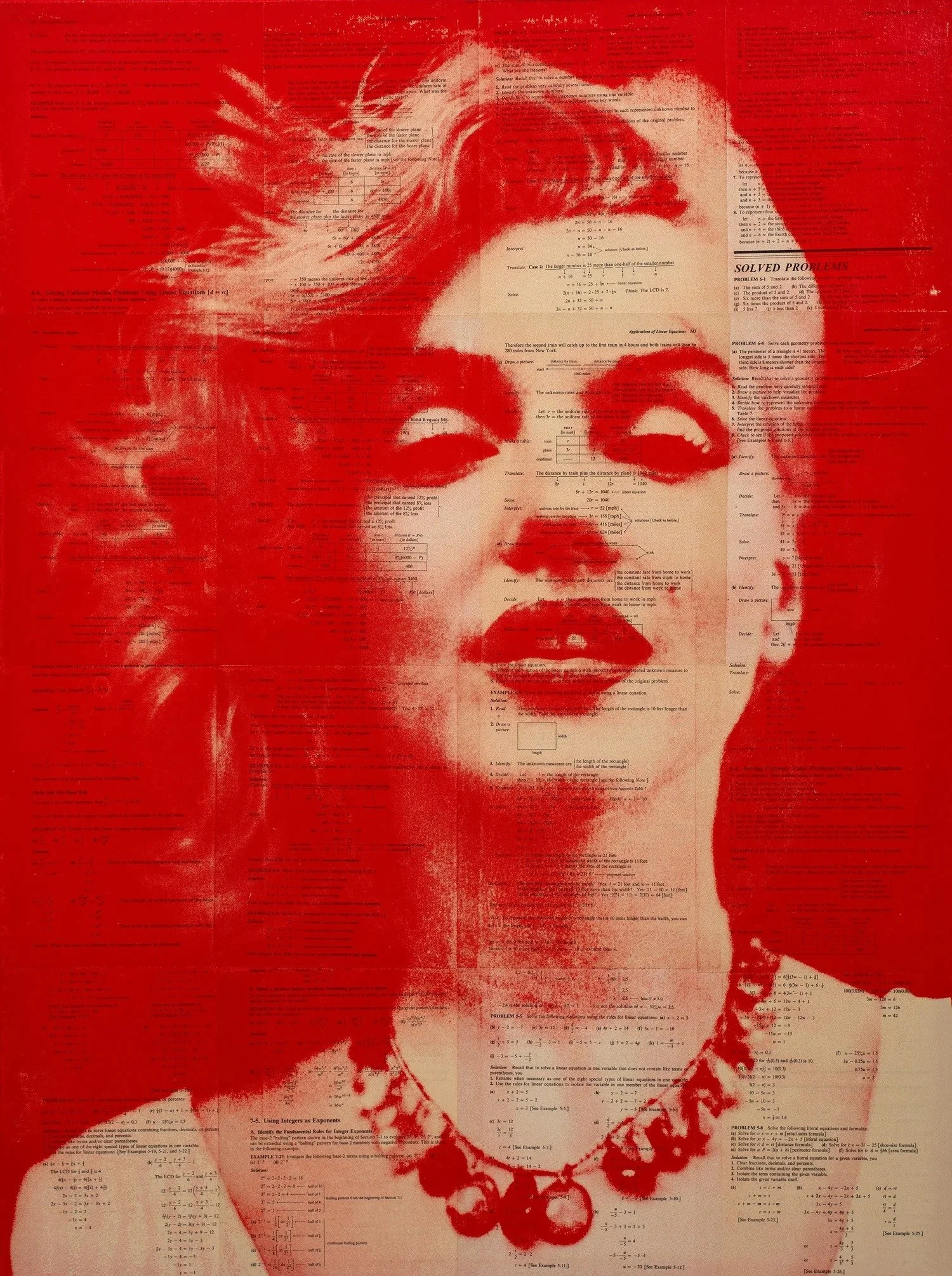
Marilyn Monroe
In 1955, one phone call from Marilyn Monroe changed the course of Ella Fitzgerald’s career. Here’s what really happened.
We tend to remember Marilyn Monroe as an image: the white dress, the platinum waves, the breathy voice. What gets left out of the poster version is that she was also generous, self-aware, and — for a white movie star at the height of 1950s segregation — quietly brave. One of the clearest examples is her friendship with the great jazz singer Ella Fitzgerald.
Two icons, two very different careers
By the mid-1950s, Ella Fitzgerald was already widely regarded as one of the finest vocalists alive. Yet because she was a Black woman in a segregated America, many of the most prestigious clubs still wouldn’t book her. Talent was never the question. The doors simply weren’t open the same way they were for white performers.
Marilyn, meanwhile, was one of the most famous faces on the planet — and, by her own account, a devoted student of Fitzgerald’s records. She reportedly credited Ella as a major influence on her own singing, listening to her albums over and over while preparing for roles.
The Mocambo story
The most famous chapter of their connection took place at the Mocambo, a fashionable Hollywood nightclub. As Fitzgerald later told it, Marilyn personally called the owner and pressed him to book Ella, promising that if he did, she would take a front table every single night. The owner agreed, Ella played the engagement, and the press attention that followed helped push her toward a new level of mainstream stardom.
Ella herself put it plainly in later interviews, remembering Marilyn as an unusually kind woman who was, in her words, ahead of her time — and crediting her with a real turn in her career.
A historian’s caveat worth keeping honest: Fitzgerald was already a star before that night, and some details of the story have been gently mythologized over the decades. But the core is true and well documented — Marilyn used her fame and her presence to open a door that was being held shut, and she did it at a moment when plenty of stars stayed silent.
Compassion as a kind of courage
That instinct wasn’t a one-off. The people around Marilyn often described someone far more thoughtful and socially aware than her public image allowed. She read constantly, she was drawn to people the industry overlooked, and she used what leverage she had on behalf of others.
In an era when speaking up carried real professional risk, choosing to sit at the front table — visibly, repeatedly, for a Black artist who’d been turned away — was its own quiet statement. It’s easy now to call it obvious. In 1955 it wasn’t.
Why she still belongs on the wall
This is the part of pop art worth lingering on: the icons we hang on our walls were real people who made real choices. A portrait of Marilyn isn’t just glamour — it’s a portrait of someone complicated, curious, and more generous than history’s shorthand suggests. And the story behind that generosity runs straight through one of the greatest voices in American music.
If you want a piece of that story for your own space, the Marilyn Monroe Painting (silkscreen on canvas, 40 × 30 in) captures her in bold red — ready to hang, signed on the back, and shipped fully insured. It’s a portrait of the woman behind the legend: striking, warm, and impossible to look away from.
Browse more original celebrity pop art and archival fine art prints in the shop, or commission a custom portrait of your own icon.
Warhol, Basquiat & Haring: Three Artists, One Downtown
Why these three names belong in the same sentence — and why I keep coming back to them in the studio.


Some artists get grouped together by historians long after the fact. Andy Warhol, Jean-Michel Basquiat, and Keith Haring got grouped together because they actually knew each other. In the early 1980s they were all circling the same downtown New York — the same clubs, the same galleries, the same restless idea that the street and the gallery were really one conversation.
Warhol was the elder statesman, and he took both younger artists under his wing. He and Basquiat became genuinely close — they worked out together, talked constantly, and made more than a hundred paintings side by side. For Basquiat it was part mentorship, part friendship, part something like family. When Warhol died in 1987, a lot of people felt it knocked the floor out from under him.
Haring orbited the same world and idolized Warhol growing up before becoming a real friend. He and Basquiat were peers who came up through the same scene — supportive rather than competitive, which was rare in a place that ran on rivalry. Three artists who refused to separate "high" art from pop culture, who embraced fame and commerce when the old guard found it vulgar, and who — heartbreakingly — all died young within a few years of one another.
The originals were created using decoupage of vintage magazine and silkscreen on canvas. They are no longer available for sale, but I'm open for commissions.
Want one for your own wall? Each portrait is also available as an archival print: Warhol print · Basquiat print · Haring print.
Original Painting vs. Fine Art Print: Which Is Right for Your Space?
One of the most common questions I get from new collectors is also one of the most practical: should I buy an original painting, or a fine art print? Both have a place in serious collections, but they’re different things — different price points, different scarcity, different relationships to the artist’s hand. This guide breaks down what actually distinguishes the two, and how to decide which one is right for the piece you’re considering.
What Original Painting Actually Means
An original painting is exactly what it sounds like: a one-of-a-kind, hand-painted work on canvas, panel, or paper. There is only one of it in the world. Every brushstroke is the artist’s direct mark, every color choice was made in real time on the surface itself. The texture, the layered acrylic, the silkscreen, the collage elements — these are all physical features you can feel up close. Originals are slower to make, more expensive, and impossible to replace. When an original sells, it’s gone.
For collectors, originals carry the strongest investment case. Their value tends to track the artist’s career over time. They’re also the truest version of a particular piece — the painting that existed first, before any reproduction. If you fall in love with a specific composition and want that painting, you want the original.
What Fine Art Print Actually Means
A fine art print is a high-quality reproduction of an original work, produced in a controlled edition using archival materials. The best prints are made using giclee printing on heavyweight matte or cotton rag paper, with pigment-based inks rated for 100+ years of lightfast life. Each print is signed and numbered by the artist, with the edition size disclosed up front.
Fine art prints are not posters. A poster is a mass-produced commercial product. A fine art print is a limited, signed, museum-quality reproduction overseen by the artist. The difference shows up in paper weight, color accuracy, surface feel, and longevity — and it shows up over decades as posters fade and prints don’t.
The Real Differences in Plain English
Originals are one-of-one. Prints are limited editions. Originals have physical texture from paint and silkscreen and collage; prints are flat (though high-quality prints reproduce that texture visually with remarkable fidelity). Originals command higher prices because of scarcity and the artist’s direct labor; prints are more accessible because the production effort is spread across the edition. Originals appreciate based on the artist’s career and the piece’s specific history; prints appreciate more modestly but still hold value as the edition sells out.
Neither is better — they answer different questions.
When an Original Makes Sense
Choose an original when the painting itself is the point — when you want this specific composition, with these specific brushstrokes, and you want it to be the only one of its kind in the world. Choose an original when budget allows and you’re investing for the long term. Choose an original when you’re decorating a primary focal wall in your home — a place where the piece will be experienced up close, daily, and where texture and depth matter to the experience.
If you’ve been collecting for a while and want to deepen your collection with a centerpiece, originals are usually the right move.
When a Fine Art Print Makes Sense
Choose a fine art print when you love the imagery but want a more accessible entry point. Choose a print when you’re decorating multiple spaces and want consistency across rooms or properties. Choose a print when you’re new to collecting and want to start with limited-edition work from artists you admire before committing to originals. Choose a print as a meaningful gift — they’re easier to ship, frame, and present than originals.
A print collection built thoughtfully over years can absolutely become significant. Some of the most respected collections in the world include both originals and prints, by design.
A Note on Mixing
The best home art collections aren’t either-or. They mix originals (often one or two anchor pieces) with prints (filling out hallways, secondary rooms, transitional spaces) and sometimes commissioned work (personal pieces in private rooms). You don’t have to choose a category — you can build a collection that uses all three.
How to Decide for the Piece You’re Considering
When you’re looking at a specific work and trying to decide, ask three questions. First: is the original still available, or is it sold? If it’s sold, the print might be the only way to live with that image. Second: where will this piece hang, and how close will the viewer be? Up-close primary spaces reward originals; further-back secondary spaces work beautifully with prints. Third: what’s the budget, honestly? Both originals and prints can be excellent purchases — the wrong move is stretching for an original you can’t afford when a print of the same image would have been a confident, lasting choice.
If you’d like help thinking through a specific piece, I’m always happy to talk it through. And if you want to browse what’s available right now — originals and prints both — the studio shop is the best starting point.

How to Commission a Custom Pop Art Portrait: Process, Pricing & What to Expect
A step-by-step guide to commissioning a custom pop art portrait — process, timeline, pricing, and what to expect at each stage of the journey from idea to finished painting.
Commissioning a custom pop art portrait is one of the most personal kinds of art purchases you can make. Unlike buying an existing piece off the wall, a commission starts with a story — a person, a moment, a face that means something specific to you — and ends with a painting that exists nowhere else in the world. If you’ve been thinking about commissioning a piece but aren’t sure how the process works, this guide walks through everything: timeline, pricing, reference photos, and what you can expect at each step.
Who Commissions a Pop Art Portrait?
The honest answer: more kinds of people than you’d think. The most common commissions are portraits of loved ones — partners, parents, children, even pets — given as anniversary, birthday, or memorial gifts. But I also paint commissioned portraits of musicians and athletes for serious fans, founders and CEOs for their offices, and historical figures for collectors who want something specific to their interests. The subject doesn’t have to be famous. It just has to mean something.
Step One: The Initial Conversation
Every commission starts with a conversation, usually by email or through the website’s contact form. We talk about who or what you want painted, what size and orientation you’re imagining, where the piece will hang, and the general feeling you want it to have. Some clients come with very specific ideas — a particular pose, a color palette, a reference to a known work. Others come with just a name and a feeling, and we figure it out together. There’s no wrong way to start.
Step Two: Choosing the Reference Photo
The reference photo is the foundation of the painting, so this step matters a lot. A great reference is sharp, well-lit, and shows the subject’s face clearly. It doesn’t have to be professional — phone photos are fine — but it should be high resolution. If you’re commissioning a portrait of someone living, this is where you’ll want to gather a few options and we’ll choose together. For portraits of public figures, I’ll source from licensed editorial photography or work from your provided reference if you own the rights.
A note on style: pop art portraiture isn’t photorealism. The painting will read as that person, but interpreted through bold color, layered marks, and the pop art visual vocabulary. If you want a literal photographic likeness, that’s a different kind of commission — and I’m happy to point you toward artists who specialize in that.
Step Three: Sketch & Color Approval
Before I start painting on canvas, I’ll send you a preliminary sketch and color palette for approval. This is the moment to make changes — adjust the composition, push the colors warmer or cooler, swap a background element. Once you sign off, the canvas work begins, and from there the piece develops as it develops. You’ll get progress photos at key stages, but the final reveal is its own moment.
Step Four: Timeline & Pricing
Most commissioned pieces take three to five weeks from sketch approval to final delivery. Rush timelines are sometimes possible for an additional fee, but I’d rather you build in the time and get the right painting than push the work and get a compromised one. Pricing depends on size, complexity, and whether you want additional features like silkscreen layering, diamond dust finish, or mixed-media collage elements. Commissions are priced by size tier, starting at $1,500. The current tiers, with sizes and deposit amounts, are listed on the commission request page. I’m always happy to give a quote based on what you have in mind — just reach out.
Step Five: Delivery, Framing & Living With the Piece
Once the painting is complete, I’ll send final photos for your approval, then carefully crate and ship the piece. For local Dallas clients, I can deliver in person. The painting arrives unframed by default — I find collectors usually have strong opinions about framing and prefer to choose their own framer to match the room. If you’d like framing recommendations or coordination, just ask.
After delivery, a custom portrait tends to become the visual anchor of whatever room it lives in. That’s part of what makes commissioning worth it: you’re not just buying an image, you’re commissioning a focal point built around a person or moment that matters.
Ready to Start?
If a custom pop art portrait sounds like the right next piece for your collection — or the right gift for someone who already collects — the easiest first step is just to reach out. Tell me a little about who you’d like painted and what you have in mind, and we’ll take it from there. There’s no obligation in starting a conversation, and most of the best commissions begin with a simple email.

What Is Pop Art? A Dallas Artist’s Guide to the Movement’s History and Modern Revival
Pop art is one of the most recognizable and influential art movements of the twentieth century — and it never really went away. A Dallas pop artist’s guide to the movement’s history, visual language, and modern revival.
Pop art is one of the most recognizable and influential art movements of the twentieth century — and it never really went away. Born in the 1950s and 60s as a rebellion against the seriousness of abstract expressionism, pop art collapsed the wall between fine art and mass culture. Today it remains the visual language of celebrity, advertising, and modern American identity. Here in my Dallas studio, I work in this tradition every day, painting the icons whose images shape how we see ourselves.
The Origins of Pop Art: From London to New York
Although it’s most associated with Andy Warhol, Roy Lichtenstein, and the New York scene of the 1960s, pop art actually started in 1950s London with the Independent Group — a loose collective of artists, critics, and architects who saw post-war consumer culture as worthy subject matter. Richard Hamilton’s 1956 collage “Just What Is It That Makes Today’s Homes So Different, So Appealing?” is often credited as the first true pop artwork. It featured a bodybuilder holding a giant lollipop labeled POP — and from that moment, the name stuck.
By the early 1960s, the movement crossed the Atlantic and exploded in New York. Warhol’s Campbell’s soup cans, Lichtenstein’s comic-strip panels, and James Rosenquist’s billboard-scale paintings turned everyday commercial imagery into gallery-worthy art. They weren’t celebrating consumer culture so much as examining it — holding up a mirror to a society that consumed images as voraciously as it consumed products.
The Visual Language: Bright Colors, Bold Lines, Familiar Faces
What makes a work recognizably “pop art” isn’t just subject matter — it’s a specific visual approach. Pop artists favor flat planes of saturated color over modeled shading. They borrow techniques from commercial printing (silkscreen, halftone dots, layered stencils) and adapt them for canvas. They isolate subjects against simple backgrounds, the way an advertisement isolates a product. And they almost always work with images the viewer already knows: a movie star, a soda bottle, a comic book panel, a flag.
In my own practice, those principles guide every painting. When I work on a portrait of Marilyn Monroe, Frida Kahlo, or Basquiat, I’m not trying to render them realistically — I’m trying to capture the image of them as it lives in our collective memory. The painting becomes a conversation between the original photograph, the silkscreen tradition Warhol established, and whatever this particular moment in time wants to say about that face.
Pop Art’s Greatest Hits: Subjects That Defined the Movement
Certain subjects became almost shorthand for pop art itself. Marilyn Monroe — Warhol’s 1962 series made her the patron saint of the movement, and she still anchors most pop art collections today. Elvis Presley, Jackie Kennedy, and other mid-century icons gave pop artists a way to comment on fame, mortality, and the American Dream. Comic book heroes (Batman, Wonder Woman, Batgirl) brought in pulp narrative energy. And brand imagery — Coca-Cola, Chanel No. 5, Campbell’s soup — turned commerce itself into subject matter.
What unites these subjects is that they were already images before any artist painted them. Pop art is fundamentally about images of images — the way a face becomes a brand, the way a brand becomes a symbol, the way a symbol gets repeated until it means something new.
Why Pop Art Still Matters in 2025
Walk into any contemporary gallery, scroll through Instagram, or browse a modern art fair, and pop art is everywhere — just reinvented for a new era. The icons have changed (Taylor Swift instead of Marilyn Monroe, sneakers instead of soup cans), but the core idea remains: art that engages with the images flooding our daily lives. Pop art works because it lives where viewers already live. You don’t need an art history degree to feel something when you see a giant silkscreen of Dolly Parton or a collage of Basquiat — the recognition is immediate, emotional, and personal.
For collectors, pop art also makes practical sense. The vocabulary is bold enough to hold a room, the references are conversation-starters, and the work tends to feel current rather than precious. It’s art that suits how we actually live now — in homes that mix modern, vintage, and personal, and that benefit from a focal point with energy.
Bringing Pop Art Into Your Own Space
If you’re drawn to pop art, the good news is there are more entry points than ever. You can collect original paintings if you want a one-of-a-kind statement piece. You can collect signed fine art prints if you want the same imagery at a more accessible price. Or you can commission a custom portrait — a piece built around someone or something that matters to you personally. The original spirit of pop art was about democratizing the image, and the market has caught up: there’s now a way for anyone who loves the movement to live with it.
If you’d like to see how this tradition translates into work made today, take a look around the studio.